
How to Recognize a Gambling Urge
► Watch: the short version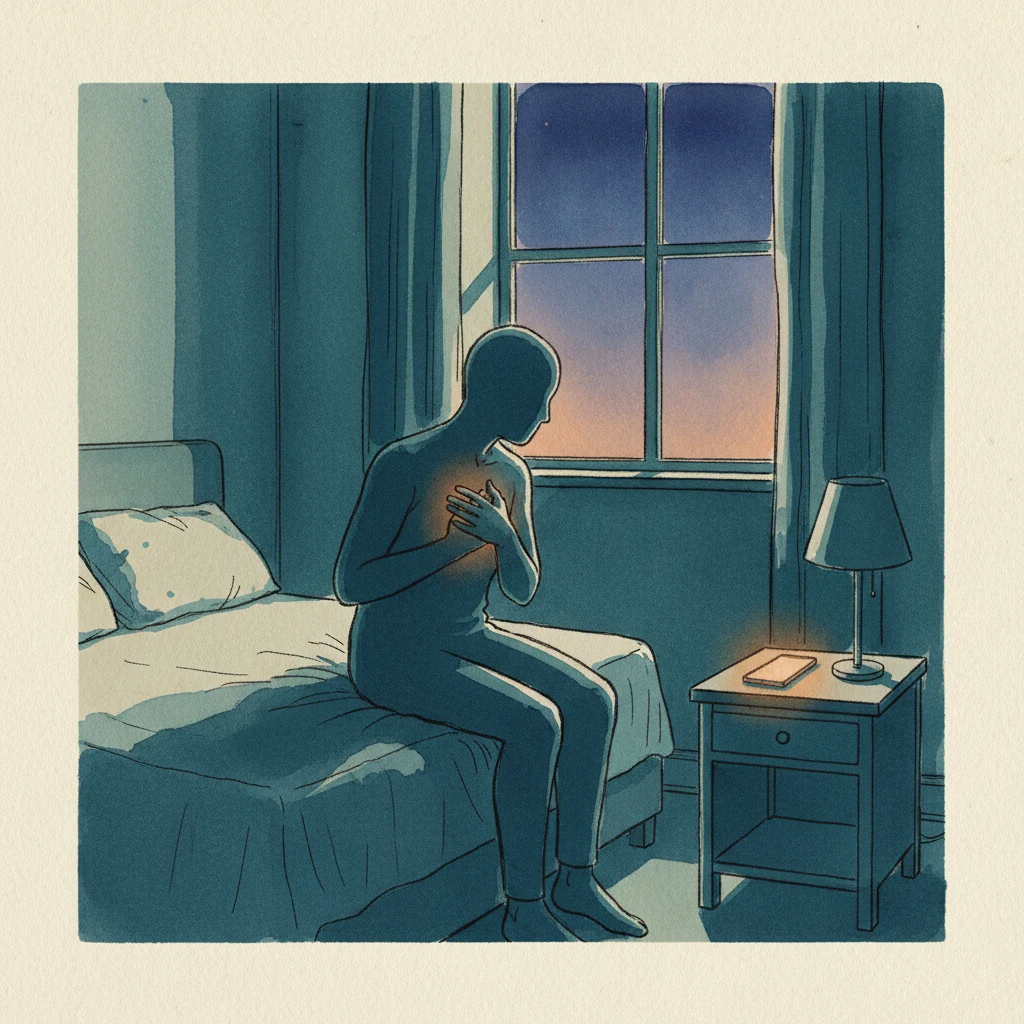
Most people miss the first half of an urge. By the time you hear the words "I'll just check the score" or "I'm only down a little," your body has already been pulling you toward the action for minutes, sometimes hours. The thought is the last step. The body is the first.
This is a field guide to your own body so you can catch the pattern earlier. The earlier you catch it, the smaller the move you have to make to interrupt it. If any of the cues below land, that is your signal to open the orb and ride one wave. You do not need to be sure.
The earlier you catch it, the smaller the move.
Early SignalsPhase 1. The Drift
Before the urge has a name, your nervous system is already off. You feel restless, irritable, vaguely wrong. Marlatt and Gordon called these the high-risk internal states. Mindfulness-Based Relapse Prevention teaches body-scan practice specifically to catch them.
Mood cues
- I feel restless and cannot settle into anything.
- I am bored in a sharp, agitated way, not a sleepy way.
- I feel low-grade lonely even when people are around.
- I feel "off" but cannot describe it.
- I feel a flat, dull mood I want to escape from.
Body cues
- My jaw or shoulders are tight for no reason I can name.
- I am hungry, tired, or wired and have not eaten or slept well.
Mind and behavior cues
- I keep picking up my phone without a reason.
- I am replaying a recent argument or financial worry on a loop.
- I am scanning for "something to do tonight."
Open the app and ride two minutes of breath. You do not need an urge to use the orb. A pause at the drift stage often prevents the acute phase from ever arriving.
The WavePhase 2. The Acute Urge
The urge has arrived when your body narrows. Attention pulls to a single object: the phone, the app, the score. Time speeds up. Your breath shortens. You start mentally rehearsing the action in detail, the login, the bet size, the screen.
Body cues
- My chest gets tight or I feel a pull in my sternum.
- I am holding my breath without realizing.
- My hands feel buzzy, hot, or tingly.
- My face is hot or flushed.
- My heart is faster than the situation calls for.
- I feel a magnetic, leaning-forward pull toward the device.
- My mouth is dry. I keep swallowing.
Perception cues
- My peripheral vision narrows. The room "shrinks" to the phone.
- Time feels distorted, either too fast or unreal.
Mind cues
- I am rehearsing the action in vivid detail in my head.
- A small voice in my head is bargaining a specific number or limit.
Open the orb and ride one wave. You are not trying to make the urge go away. You are watching it rise, peak, and fall while you stay still. Most acute urges peak within twenty minutes if you do not feed them.
The Danger ZonePhase 3. The Fog
This is the most dangerous phase because it does not feel like an urge anymore. It feels like calm. You are already walking toward the action and your mind has gone quiet to let you. Time loss is the signature. You "come to" five or fifteen or sixty minutes later already logged in, already placing, already down.
Mood cues
- I feel strangely calm and focused on a task.
- I feel a flat, almost bored numbness.
Mind cues
- I am not really thinking. I am just doing.
- I lost a chunk of time and cannot account for it.
- I feel detached from my body, like watching myself.
- I am justifying in short phrases: "just one," "just to see."
Behavior cues
- I notice I have already opened the app or the browser.
- I am moving with a smooth, automatic quality.
- I am avoiding eye contact with people in the room.
- I notice I stopped responding to texts.
If you noticed you are in the fog, you are already partway out. Open the orb. Stand up. Speak out loud to break the trance. Text your sponsor or one of the people in your contacts.
The DisguisesCommon Decoys
The disorder negotiates in plain English. These are the most common disguises.
- "I'm just bored." Boredom that pulls toward the phone is a drift cue, not boredom.
- "I just need to check the score for fantasy."
- "I just want to see how much I'm down."
- "I'm only looking, not betting."
- "I've been good. I've earned a small one."
- "It's research. I'm studying the lines."
- "One more and I'll be even."
- "I had a hard day."
- "Everyone else is doing it tonight."
The ResearchThe Gambling-Specific Cluster
Substance urges tend to be about a substance. Gambling urges are about a story. Hodgins and el-Guebaly's research found gambling-relapse precipitants cluster around three feelings substance work does not always capture.
The chasing pull. A specific, almost mathematical certainty that one more bet evens the ledger. It feels like logic, not craving. This is the single highest-frequency relapse precipitant in pathological-gambling samples.
Post-win overconfidence. A warm, expansive feeling after a win, real or imagined, that says the system is working and you should press. The post-win window is uniquely dangerous in gambling because of how reinforcement works.
The 3am-alone cluster. Late night, phone in hand, partner asleep, the world quiet. The urge here is less hot and more inevitable. A slow gravity. This is when most relapses happen.
If any of these three feels familiar, the orb is the right move even if you do not feel "in crisis."
The RuleIf You're Asking, That's the Answer
One rule. If you are asking yourself "is this an urge?" the answer is yes, open the orb. The healthy nervous system does not stop to interrogate itself about gambling. The question is the cue.
You do not need certainty. You do not need the urge to be bad enough. You do not need to wait until you have a clear thought. A body cue is enough. A vague off feeling is enough. A "just checking" is enough.
Open the orb. Ride one wave. See what is actually here.
Sources
- Marlatt, G. A., and Gordon, J. R. (1985). Relapse Prevention: Maintenance Strategies in the Treatment of Addictive Behaviors. Guilford Press.
- Bowen, S., Chawla, N., and Marlatt, G. A. Mindfulness-Based Relapse Prevention for Addictive Behaviors (2nd ed., 2021). Guilford Press.
- Hodgins, D. C., and el-Guebaly, N. (2004). Retrospective and prospective reports of precipitants to relapse in pathological gambling. Journal of Consulting and Clinical Psychology, 72(1), 72–80.
- Petry, N. M. (2005). Pathological Gambling: Etiology, Comorbidity, and Treatment. American Psychological Association.
- Hayes, S. C., Strosahl, K. D., and Wilson, K. G. Acceptance and Commitment Therapy (2nd ed., 2012). Guilford Press.
- Porges, S. W. (2011). The Polyvagal Theory. W. W. Norton.
Related articles
Find help near you
Cope Compass is free.
Real-time support that learns your patterns and adapts to your recovery over time. The more you use it, the better it understands your triggers.
Try it now