Is Roblox Gambling? The Robux Casino Risk for Kids
By Austin Taylor, Cope Compass
A federal judge in California ruled in December 2025 that Robux, the play-money currency tens of millions of children spend inside Roblox, are a "thing of value" under gambling law. That ruling let a lawsuit proceed against the operator of a site where kids wager those Robux on coin flips and roulette. If you are a parent, that one sentence reframes a platform you probably thought of as a harmless sandbox. If you are an adult in gambling recovery with a child who plays, it should get your full attention.
This is not a story about one bad app. It is about how a platform built for children, with a real-money virtual economy at its center, has grown a gambling ecosystem on its edges. Below is what the design actually does, where the gambling lives, what the research says about where it leads, and what to do about it without lecturing or panicking.
The PlatformWhat Roblox Actually Is, and Why the Design Matters
Roblox is not a single game. It is a platform hosting millions of user-made experiences, monetized through one currency: Robux. Children buy Robux with real money, roughly $1.25 per 100 Robux at retail, then spend them inside experiences on items, access, and randomized rewards. Developers who earn Robux can convert them back to cash through Roblox's Developer Exchange program, or DevEx, currently about $0.0038 per earned Robux, a rate raised from $0.0035 in September 2025 (Roblox DevEx help page). That two-way bridge, real dollars in, real dollars out, is the detail that makes the economy more than play money.
The audience is young. In its February 2026 shareholder update, Roblox reported 144 million daily active users, and among those who had completed an age check, 35 percent were under 13, 38 percent were 13 to 17, and 27 percent were 18 or older (Roblox newsroom, Feb 2026). In April 2026, the company announced new age-based account tiers, a Kids tier for ages 5 to 8 and a Select tier for ages 9 to 15, rolling out in June 2026 (Roblox newsroom, Apr 2026).
The engagement design is the part parents rarely see named. Several mechanics overlap with the ones that make gambling sticky:
Variable-ratio rewards. Many experiences sell randomized items, the same uncertain-reward schedule slot machines use. You pay, you do not know what you get, and the near-miss drives the next purchase. We covered this mechanic and the 2025 longitudinal data in depth in Your Kid's Loot Boxes Are Training Them for Sports Betting. This piece is about the platform those mechanics live on.
A real-money currency loop. Because Robux convert to and from dollars, an item that "feels" free to a child has actual market value. That is the bridge from play to wagering.
Social-status pressure. Rare items, limited drops, and resellable collectibles create a culture where what you own signals where you stand. For an eleven-year-old, that pressure is not trivial.
Near-infinite content. Millions of experiences mean the feed never ends. Endless novelty is its own retention engine, and it makes the gambling-style corners harder for any parent to fully see.
None of that is illegal, and none of it is unique to Roblox. It matters because of who is on the platform and because of what sits one click outside it.
The MechanismThe Gambling Connection: Robux Casino Sites
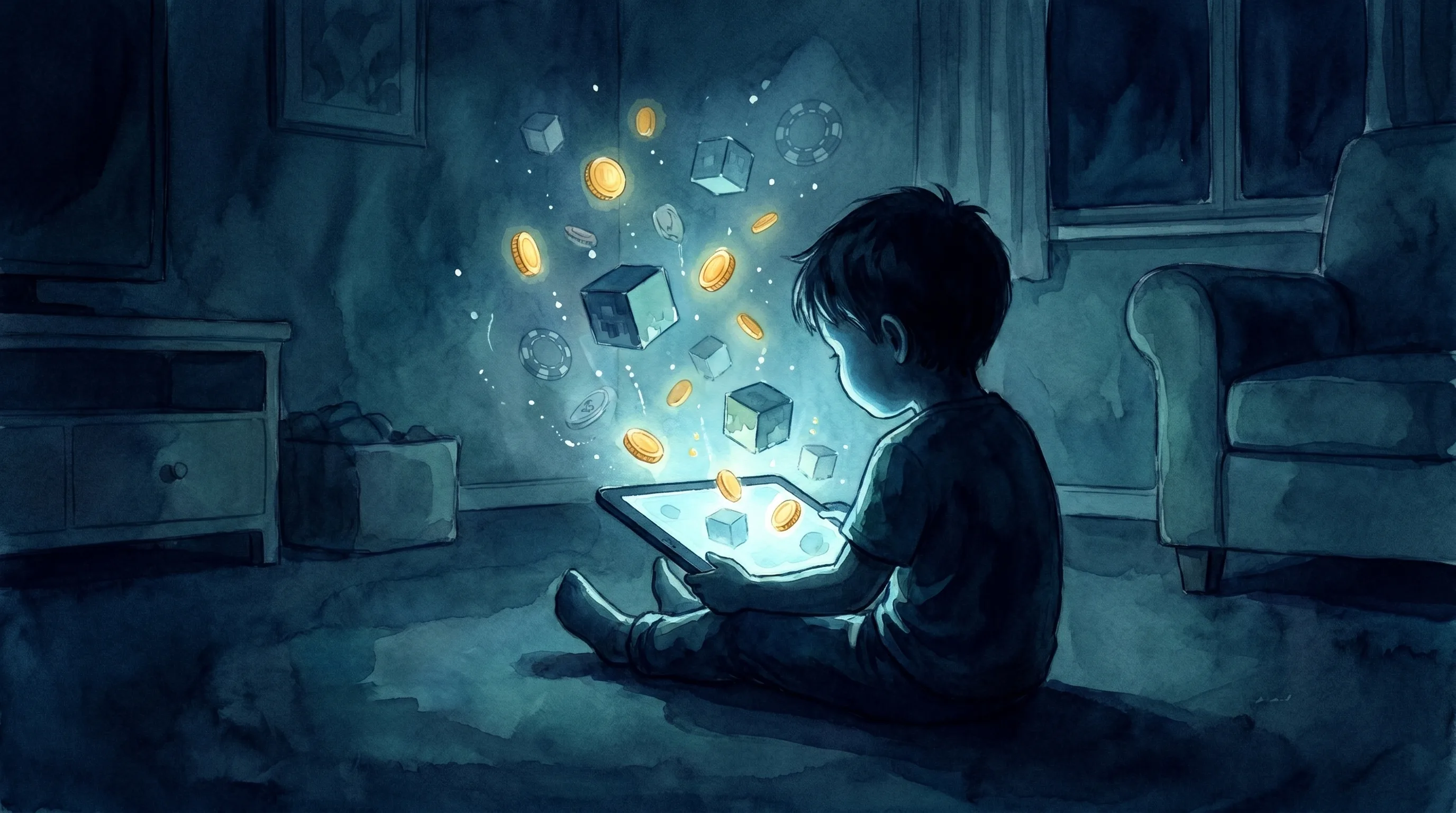
The clearest gambling harm is not inside official Roblox experiences. It is on third-party sites that exist solely to let people wager Robux. Sites in this class, including RBLXWild, Bloxflip, and RBXFlip, run virtual casinos: coin flips, "crash" games, roulette, and similar bets, staked in Robux. A child links a Robux wallet, converts it to site credits, and gambles. Losses are real. Robux have a dollar value going in, and through DevEx, a dollar value coming out.
A class action filed in the Northern District of California in August 2023, Colvin et al. v. Roblox Corporation et al. (case 3:23-cv-04146), names Roblox alongside the operators of RBXFlip (Satozuki Limited B.V.), Bloxflip (Studs Entertainment Ltd.), and RBLXWild (RBLXWild Entertainment LLC). The complaint alleges the platform's currency and 30 percent transaction commission let it profit from an operation that "prey[s] on children nationwide," with parents unknowingly funding gambling because they believe Robux purchases support ordinary gaming (ClassAction.org summary).
On December 10, 2025, U.S. District Judge Vince Chhabria denied RBLXWild operator Boris Said Jr.'s motion to dismiss, ruling that Robux are a "thing of value" under California law and letting unfair-competition claims, predicated on illegal gambling, along with negligence and unjust-enrichment claims, proceed. The judge noted it would be "strange to conclude that RBLXWild was not operating a game involving a thing of value when it was able to convert that thing, the Robux, to cash," and pointed to the site generating up to five figures a day through Roblox's exchange program (Casino.org, Dec 2025).
Roblox's position is that these are unaffiliated bad actors. The company has said such sites "have no legal affiliation to Roblox whatsoever" and make "illegal use of Roblox's intellectual property and branding." That may be true as a matter of corporate structure. It does not change what a child experiences: a familiar currency, a one-tap link, and a casino. New sites in this class appear as fast as old ones are shut down or sued, the same pattern recovery clinicians have watched in the skin-betting ecosystem for a decade.
The StakesWhy Early Exposure Is the Real Risk
The reason this matters for a recovery audience is not the dollars a child loses this week. It is what the exposure trains.
A British Columbia research team led by Drummond replicated, in a second independent cohort with longitudinal controls, that loot-box spending predicts later real-money gambling, not the reverse (open-access study, PMC). Earlier work by Zendle and colleagues found the same association across large surveys, and a natural experiment showed that players at high risk of problem gambling cut their spending sharply when a game removed loot boxes, while others did not. The direction of the effect is now well supported: the randomized-reward habit comes first, the gambling follows.
Layer that onto exposure scale. NCPG's February 2026 national survey, conducted by The Harris Poll, found that 65 percent of U.S. adults reported gambling before age 21, and that 66 percent of Americans were concerned about underage exposure to gambling or gambling-like activities, rising to 71 percent in households with children under 18 (NCPG, Feb 2026). Adolescent problem-gambling rates already run higher than adult rates in most studies.
The clinical picture is consistent. Gambling disorder, coded F63.0 in ICD-10 and 312.31 in the DSM-5, is built on intermittent reinforcement, loss chasing, and the cognitive distortion that the next attempt will reverse the last loss. A Robux casino delivers all three to a child whose reward circuitry is still forming. The yRAFFLE work on children ages 10 to 14 found the top motivations for engaging with these mechanics were anticipation and chasing losses, the same two motivations that dominate adult gambling disorder. The platform is not just where kids play. For some, it is where the pattern is rehearsed.
Warning SignsWhat Parents and People in Recovery Should Watch For
You are not looking for "does my kid play Roblox." Almost every child does. You are looking for the gambling-specific signals:
- A second site or app you do not recognize. The casino lives off-platform. A browser history or a friend group that talks about "flips," "crash," or "cashing out" Robux is the flag, not Roblox itself.
- Robux spending that escalates or hides. Check card statements and gift-card balances. Secrecy about purchases, more than the playing itself, is the signal.
- Mood crashes after a loss. Disproportionate anger or withdrawal after a "bad pull" or a lost flip, then a quick return to spend again, is loss chasing in miniature.
- "I just need to get my Robux back." That sentence, in any form, is the chasing distortion. Take it seriously.
- Sleep, school, or a friendship sliding. Downstream effects matter more than raw screen hours.
First StepsWhat to Actually Do: Reduce Access, Remove the Cue
The goal is not "safer Robux spending." There is no safe wagering threshold for a child, and framing it that way teaches the wrong lesson. The goal is to cut access and remove the cue.
Lock the wallet. Turn on app-store purchase controls so Robux cannot be bought without you. On iPhone: Settings, Screen Time, Content and Privacy Restrictions, set In-App Purchases to "Don't Allow." On Android: Google Play, Settings, require authentication "For all purchases." This ends the frictionless top-up that funds everything downstream. Our full walkthrough on cutting digital access is in How to Block Gambling Apps and Sites.
Set the account tier. Use Roblox's age-based accounts and parental controls, and verify the age on the account is correct. The Kids and Select tiers restrict content and communication. They do not block external casino sites, so treat them as one layer, not the answer.
Block the casino domains. Add the known Robux-casino domains to a network-level blocklist or your router's content filter. New ones appear, so this is maintenance, not a one-time fix.
Have the conversation, not the lecture. Two sentences beat a speech: "I read that some sites let kids gamble Robux on coin flips, and a judge just called it real gambling. I'm not taking the game away. I want to know what you're playing and agree on limits together." A child who plays already understands these mechanics better than you do. Lead with curiosity.
If it has already escalated, treat it as gambling. Do not wait for a bigger loss. Call the National Problem Gambling Helpline at 1-800-GAMBLER, free, confidential, and available 24/7. It handles calls about adolescent gambling and routes families to local help. SAMHSA's helpline, 1-800-662-HELP, is a second option for families.
A note on Cope Compass: our tools are built for adults in gambling recovery, not for children, and we would not suggest an app as a solo intervention for a minor. We raise it here because nearly every adult we work with describes a pattern that started younger than they realized: a pack, a spin, a flip, at twelve or thirteen. The road back is shorter the earlier a family catches it. If something feels off, that instinct is worth trusting. The research is on your side.
If you are an adult in recovery navigating your own cues while parenting through this, you do not have to do it alone. Start by joining Cope Compass to build a personal plan and find a meeting through our Gamblers Anonymous directory, and download the app so support stays with you on the hard days. And if you want to talk to someone right now, the National Problem Gambling Helpline is free, confidential, and available 24/7 at 1-800-GAMBLER.
Sources
- Robux Have Value: RBLXWild Founder Loses Bid to Dismiss Gambling Claims, Casino.org, Dec 2025: Judge Chhabria's December 2025 ruling that Robux are a "thing of value," and the claims that survived.
- Order on the motion to dismiss, Colvin v. Roblox (Boris Said), U.S. District Court, N.D. Cal., Dec 10, 2025: primary court order denying dismissal of the unfair-competition, negligence, and unjust-enrichment claims.
- Class Action Claims Roblox, Casino Websites Operate Illegal Gambling Ring Targeted at Children, ClassAction.org: Colvin v. Roblox case details, named operators, 30 percent commission allegation.
- Moving Beyond Self-Reported Age, Roblox Newsroom, Feb 2026: 144M DAU, age-check breakdown (35% under 13).
- Introducing Roblox Kids and Select Accounts, Roblox Newsroom, Apr 2026: new age-based account tiers, June 2026 rollout.
- Developer Exchange Help and Information Page, Roblox: DevEx conversion rate and mechanics.
- Drummond et al., longitudinal replication of loot-box and real-money gambling associations, PMC12044733: direction of effect, loot-box spending predicts later gambling.
- Survey Finds Widespread Gambling Participation Before Age 21, NCPG, Feb 2026: Harris Poll data, 65% gambled before 21, 66% concerned about youth exposure.
- National Problem Gambling Helpline: 1-800-GAMBLER.
- SAMHSA National Helpline: 1-800-662-HELP (4357).
Related articles
Find help near you
Cope Compass is free.
Real-time support that learns your patterns and adapts to your recovery over time. The more you use it, the better it understands your triggers.
Try it now