
The Lost Generation Is on Both Sides of the Atlantic
The catalystThe story that crossed the ocean first
On May 30, 2026, the journalist Chloe Combi published an investigation in The Independent titled "A lost generation of teens is becoming addicted to online gambling, and every parent should be worried about it." It is worth reading in full. Combi's reporting is the catalyst for this piece, and her central argument deserves to be heard clearly: gambling has lost all of its old friction.
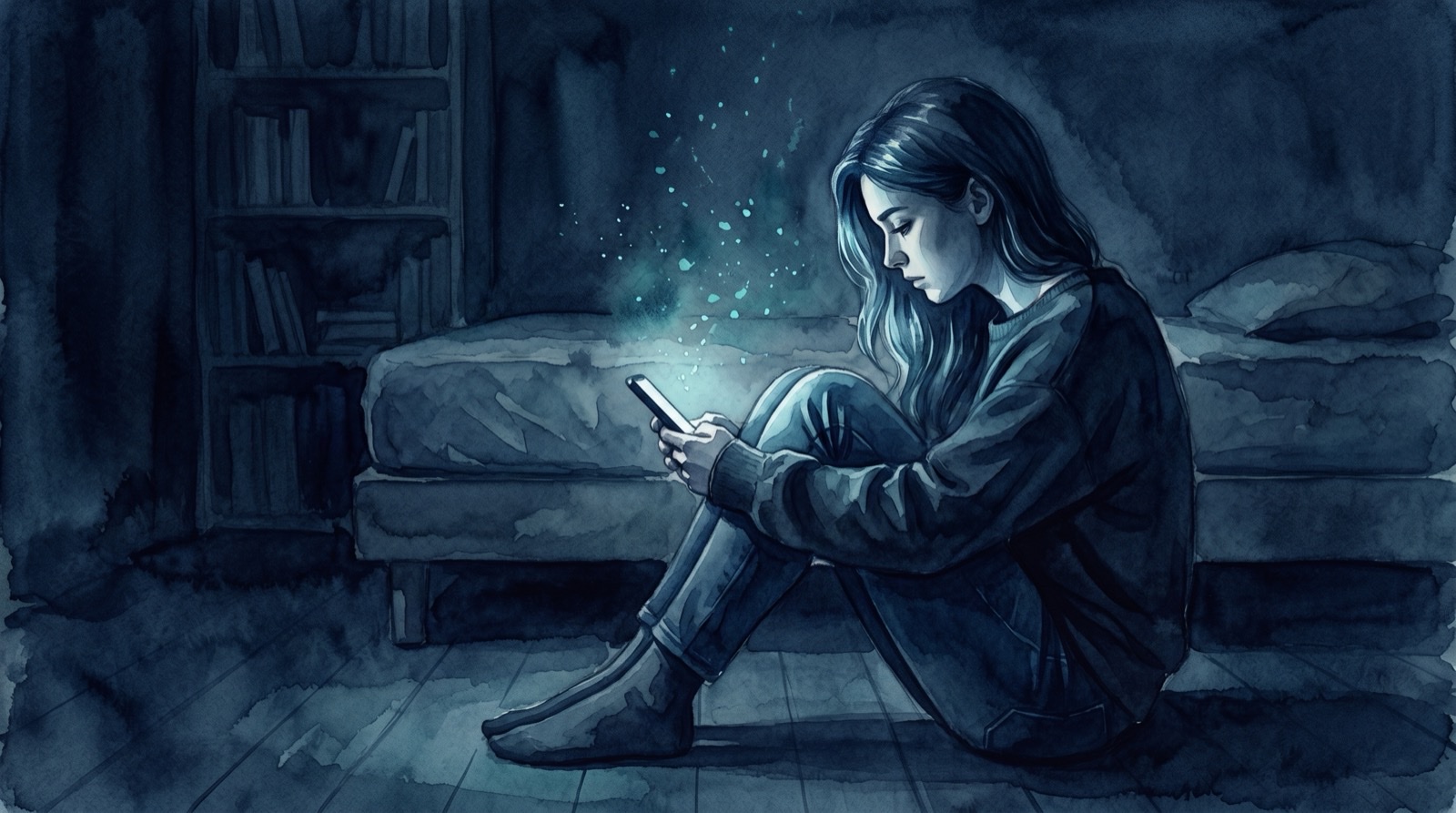
There used to be a building you had to walk into. A counter, a clerk, an age check, cash you could see leaving your hand, a closing time. Combi documents how, for the generation raised on smartphones, every one of those barriers is gone. Gambling is now in-pocket, always open, and camouflaged. It hides inside video games, inside crypto apps, inside streaming culture, and it is marketed by influencers who reframe reckless betting as aspirational.
She tells three stories. Charlie, who started at 15 by betting on streamed fights, bypassed age checks using a parent's emergency credit card, and ran up thousands in debt. Tom, who blew a 3,000-pound inheritance from his late grandfather in under three weeks through messaging-app casinos, and who is now, in his own word, "chasing it." And Saul, a young man who died by suicide carrying roughly 23,000 pounds of hidden gambling debt that his family did not know existed.
Combi's piece is set in Britain. But every structural force she names is already operating in the United States, and in several cases the American version is bigger.
The UK dataWhat the UK numbers actually say
Combi cites the UK Gambling Commission's annual survey of young people. We went to the primary source to confirm the figures.
The Commission's Young People and Gambling 2025 release, published November 13, 2025, reports that 30 percent of 11-to-17-year-olds spent their own money on gambling in the previous 12 months, up from 27 percent the year before. Forty-nine percent had experienced gambling of some kind in the past year. The survey, conducted by Ipsos, drew on responses from 3,666 pupils across England, Scotland, and Wales.
One honest note on the data: the Commission's own "problem gambling" rate for this age group sat at 1.2 percent, statistically stable. That figure tracks a narrow clinical screen and does not capture the larger population of young people who are gambling early, often, and in ways that train the brain for later harm. The trend Combi is documenting is about exposure and normalization, the on-ramp, not just the small share who already meet a threshold. Both things are true at once.
The US pictureThe American version is already here
The United States ran a natural experiment. In 2018, the Supreme Court struck down the federal ban on sports betting (the PASPA decision). What followed was one of the fastest consumer-behavior shifts in modern American life.
According to American Gaming Association figures and industry revenue tracking compiled by Sports Handle, the annual sports betting handle in the US grew from roughly $4.6 billion in 2018 to about $149.6 billion in 2024, a 23.5 percent jump over 2023 alone. Sports betting is now legal in 40 states plus the District of Columbia. More than half of American adults can open a regulated sportsbook on their phone tonight.
The youngest adults are absorbing the most risk. The National Council on Problem Gambling's 2024 National Survey on Gambling Attitudes and Gambling Experiences (NGAGE 3.0), conducted by Ipsos with more than 3,000 US adults from January to March 2024, found a steep age gradient: 15 percent of adults ages 18 to 34 reported a problematic gambling behavior many times in the past year, versus 2 percent of those 55 and older.
NGAGE 3.0 also found that men reported gambling-related problems at roughly double the rate of women, and that fantasy-sports bettors (24 percent) and traditional sports bettors (17 percent) carried far higher rates of problematic behavior than the general population. Parlay betting, the high-margin format that stacks multiple long-shot outcomes, nearly doubled, from 17 percent of sports bettors in 2018 to 30 percent in 2024.
This is the same picture Combi paints in Britain, rendered in American data: young, male, phone-first, sports-shaped.
The mechanismWhy young brains are the target, not a coincidence
Combi notes that the brain's risk-assessing frontal regions are still maturing into the mid-twenties. That framing is broadly supported by neuroscience, with one caveat worth stating honestly: there is no magic switch at age 25. As the National Institute of Mental Health explains in The Teen Brain: 7 Things to Know, the prefrontal cortex, which governs planning, impulse control, and weighing consequences, is among the last regions to fully mature, and development continues into the twenties. The "25" number is a useful shorthand, not a hard biological deadline.
What matters for recovery is the practical consequence: products engineered to exploit impulsivity, anticipation, and loss-chasing meet a brain whose braking system is still being built. That is not an accident of marketing. It is the marketing.
Combi reports that gambling advertising aimed at young men deliberately deploys words like "brave," "warrior," and "winner" to frame betting as proof of belonging, of being "one of the lads." We quote that language here to expose it, not to echo it. It is a manipulation tactic: take a vulnerable identity need (status, belonging, masculinity) and attach it to a product that profits from loss. When you can see the trick, it loses some of its grip. That is also why, in Cope Compass's own voice, we do not use that vocabulary. The words are part of the hook.
Dr. Darragh McGee, a senior lecturer in the Department for Health at the University of Bath and author of the May 2026 book Imitation Games: How Gambling Hijacked Sport, describes how online betting fused itself to sport so thoroughly that "young people's formative encounters with sport are also encounters with a litany of gambling brands." In-play betting, he notes, carves a single match into hundreds of micro-events, each one a fresh prompt to bet, available 24/7. For US readers, that is the same machinery behind microbetting and same-game parlays. We break down why those formats are uniquely dangerous in Microbetting Addiction: Why 30-Second Bets Are So Dangerous.
The camouflageThe camouflage: gaming, crypto, and the "degen" reframe
The frictionless part is only half of it. The other half is that a lot of this no longer looks like gambling.
It starts younger than a sportsbook account. Randomized paid rewards in video games, loot boxes, run on the exact reinforcement schedule a slot machine uses, and 2025 longitudinal research confirmed that loot-box spending in adolescence predicts real-money gambling later. We cover that evidence in Your Kid's Loot Boxes Are Training Them for Sports Betting. From there the path runs through crypto and "sweepstakes" casinos that present themselves as games, and prediction markets that present themselves as forecasting rather than betting. See Prediction Market Addiction for how that particular framing disarms smart, skeptical people.
Combi also names "degen culture," the online aesthetic that reframes reckless betting as a flex, a personality, a badge. It travels on the same platforms young people already live on. Her reporting notes that sports-adjacent gambling sponsorship is now near-total at the elite level, with the overwhelming majority of top competitive esports teams carrying gambling sponsors. The throughline is consistent: the bet is no longer a discrete act you choose. It is the water the culture swims in.
The bet is no longer a discrete act you choose. It is the water the culture swims in.
The human costThe part that is not about money
Saul's story in Combi's reporting is the one that has to change how we talk about this. He did not die because of a budgeting failure. He died carrying hidden debt and the shame that kept it hidden.
The clinical evidence is unambiguous. A 2021 study in The Lancet Public Health by Heather Wardle and Sally McManus, drawing on 3,549 people aged 16 to 24 in Great Britain, found that young men with problem gambling had an adjusted odds ratio of 9.0 for attempting suicide compared with their peers (4.9 for young women). You can read the study record on PubMed.
Gambling disorder is a recognized clinical condition, coded F63.0 in the ICD-10 and 312.31 in the DSM-5. It is treatable. But the secrecy that defines it, the hidden accounts, the hidden debt, the hidden shame, is exactly what turns a treatable condition into a fatal one. The single most protective thing a struggling young person can do is the hardest: say it out loud to one person. The single most protective thing a parent or friend can do is make that confession survivable. No yelling, no "how could you," no math lecture. Just: tell me, I am not going anywhere.
If you are reading this in a dark moment, please stop here and reach out now. In the US, call or text 988 for the Suicide and Crisis Lifeline. For gambling specifically, call the National Problem Gambling Helpline at 1-800-GAMBLER, available 24/7 and confidential. You do not have to have a plan or the right words. You only have to make the call.
What helpsWhat actually helps a young person
Shame does not work. Combi's reporting and the clinical literature point the same direction: the young people who recover are the ones who get connection, structure, and tools that meet the harm where it lives, on the device in their hand.
The line goes down. Even with slips, the line goes down.
That means a few concrete things:
- Cut access first, not motivation. Willpower against an always-open app is a losing matchup. Blocking software, device-level controls, and self-exclusion remove the option in the moment the urge spikes. Our guide on how to block gambling apps walks through the specific tools.
- Treat the urge as a wave, not a verdict. Cravings are time-limited. A craving rides up and falls within minutes if you do not feed it. Learning to recognize the body cues before the thought arrives is a trainable skill: see How to Recognize a Gambling Urge.
- Replace secrecy with connection. Isolation is the accelerant. Peer support, a sponsor, a recovery community, or simply one trusted person who knows the truth changes the trajectory. Gamblers Anonymous is free and runs in all 50 states and online; here is how to find a GA meeting.
- For parents: lead with curiosity, not control. The conversation matters more than the verdict. College Students and Gambling: What Every Parent Should Know and Gambling Ads Are Targeting Your Kids are built for exactly this conversation.
If you are not sure where to start, start here: find help. And if it is urgent, call or text 988, or call 1-800-GAMBLER. Someone is there right now.
Sources
- Chloe Combi, "A lost generation of teens is becoming addicted to online gambling," The Independent, 30 May 2026. The originating investigation and its case studies (Charlie, Tom, Saul), the ad-language framing, and the experts featured.
- UK Gambling Commission, Young People and Gambling 2025 (13 Nov 2025). 30% of 11-17s spent own money on gambling (up from 27%), 49% past-year experience, 1.2% problem rate, Ipsos methodology.
- NCPG, NGAGE 3.0 survey findings (2024). 15% of 18-34s vs 2% of 55+ reporting problematic behavior; men ~2x women; parlay and sports-bettor risk rates; methodology.
- Sports Handle, US legal sports betting revenue and handle database. Handle growth from ~$4.6B (2018) to ~$149.6B (2024); state legalization count.
- Wardle H, McManus S. Suicidality and gambling among young adults in Great Britain. Lancet Public Health, 2021 (PubMed record). Adjusted odds ratio 9.0 (men) / 4.9 (women) for attempted suicide among 16-24s with problem gambling.
- NIMH, The Teen Brain: 7 Things to Know. Prefrontal cortex maturation into the twenties; the careful framing on the "25" shorthand.
- Darragh McGee, Imitation Games: How Gambling Hijacked Sport (Bodley Head, May 2026). In-play betting, micro-events, and gambling's fusion with sport for young fans.
- 988 Suicide and Crisis Lifeline and the National Problem Gambling Helpline, 1-800-GAMBLER. 24/7 crisis and gambling-specific support.
Related articles
Find help near you
Cope Compass is free.
Real-time support that learns your patterns and adapts to your recovery over time. The more you use it, the better it understands your triggers.
Try it now